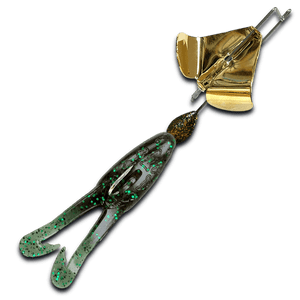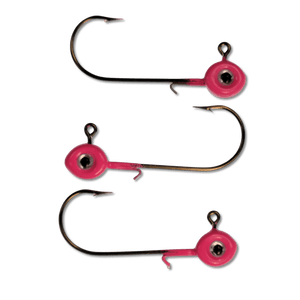







Dougs Custom Lures Weighted Swim Bait Hooks
$5.99
(No reviews yet)

Write a Review

Dougs Custom Lures Weighted Swim Bait Hooks

Doug's Take
"The weight and the keeper are what make this hook worth carrying. Without a keeper, a swimbait slides down the hook on every cast and every fish — you're constantly re-rigging instead of fishing. The belly weight does the same job as a separate sinker but keeps the rig clean. Pick your weight for the depth you're fishing, thread on a Rippin' Shad, and you're done. It's a simple rig that produces all season long."
— Doug, founder · Doug's Custom Lures · Milwaukee, WI
The Keeper. The Weight. One Clean Rig.
The DCL Weighted Swimbait Hook is a black-nickel EWG-style hook with a molded belly weight and a corkscrew keeper on the shank. The keeper locks the nose of a paddle-tail swimbait in place so it tracks straight on the retrieve and doesn't slide down the hook under load.
The belly weight gets the bait down and keeps it running at depth without a separate sinker — the whole rig is the hook, the bait, and the line. Available in two hook sizes and four weights. The 3/0 covers finesse presentations and walleye. The 4/0 handles bigger baits and harder hooksets in cover.
Primary trailer: DCL 3.75" Rippin' Shad and DCL 3.75" Coreshot Rippin' Shad. Pick your weight for the depth you're fishing and you're done.
Keeper Locks The Bait
The corkscrew keeper drives into the nose of the swimbait and holds it in place through casts, retrieves, and fish. No sliding, no re-rigging, no wasted time. A straight-tracking bait catches more fish than one that's rotating or listing to one side.
Belly Weight Gets You Down
The molded belly weight sinks the bait to depth without a separate sinker on the line. Keeps the rig compact, the entry clean, and the presentation natural. Choose your weight based on how deep you're fishing and how fast you need to get there.
Two Hook Sizes, One System
The 3/0 is the right hook for smaller paddle-tail profiles, finesse presentations, and walleye. The 4/0 handles larger baits, heavier cover, and hard-pulling bass. Both share the same corkscrew keeper and belly weight system.
Fishes Three Ways
Slow roll it along the bottom. Speed it up for a mid-column reaction retrieve. Or swim it through grass edges and alongside dock pilings like a swim jig without the head. The hook and weight handle any of those presentations — the retrieve is the only variable.
- Feel the tail on your rod tip. If you can't feel the paddle tail thumping on a slow retrieve, you're either going too fast or the bait isn't rigged straight. Slow down until you feel it, then find the speed that keeps it working without going faster than the fish want.
- Match weight to depth, not just speed. A 1/16 oz hook fished fast still won't get a swimbait to 12 feet. Pick the weight that gets you to the right depth at a natural retrieve speed — then adjust from there.
- On windy days, go one weight class heavier. Wind affects your line and your ability to feel the bait. The extra weight keeps contact and keeps the bait tracking where you want it instead of drifting with the current.
- For walleye, slow down more than you think. Walleye key on a tighter, slower tail kick than bass. Drop to the lightest weight that still gets you to the right depth and slow your retrieve until the tail is barely moving. That subtle pulse is what walleye commit to.
- Let the bait deflect. When it ticks a rock, a dock post, or any hard structure — don't stop the retrieve. That sudden change in direction is what triggers reaction strikes from fish that were tracking the bait but hadn't committed.
On-the-water overview (demo copy)
This is placeholder text for Jiggin’ Johnson’s new template shell.
Once we’re happy with the layout and behavior, we’ll plug in real product
descriptions, rigging tips, and JJ-specific language.
Specs & build (demo copy)
Specs & build (demo copy)
Care & storage (demo copy)
Care & storage (demo copy)
Best ways to fish it (demo)
Swim Jig Trailer
Shallow grass, slow roll
Texas Rig
Pitching to cover
Ball Jig Head
Dragging sand or rock
Split Shot
Natural subtle glides