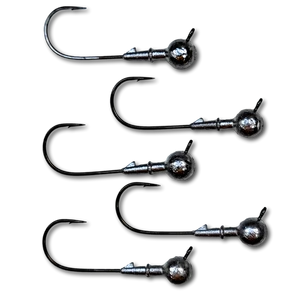







Dougs Custom Lures Arky Head Jig
$6.99
(No reviews yet)

Write a Review

Dougs Custom Lures Arky Head Jig

Doug's Take
"The arky jig is my number one bait for anything I'm flipping or pitching into cover. When I'm around wood — laydowns, dock posts, brush piles — this is what I'm throwing. The head shape is what separates it from a football or a ball head in cover. It comes through cleaner, falls on the right angle, and I've never had a problem with it rolling off structure the way a rounder head will. Pair it with the right trailer and it's hard to beat."
— Doug, founder · Doug's Custom Lures · Milwaukee, WI
Built For Cover. Four Ways To Fish It.
The Doug's Custom Lures Arky Head Jig is the bait Doug reaches for when he's fishing cover — flipping heavy wood, pitching to laydowns, punching sparse mats, or dragging along hard bottom transitions. The arky-style head is a low-profile, flat-bottomed design that keeps the hook riding up on the fall and resists rolling on the bottom. That head geometry is what makes it reliable in tight cover: it deflects off branches and stumps instead of hanging up, so it stays in the strike zone on every cast.
The weedguard is full and stiff — built to punch through laydowns and brush piles without snagging, and designed to trip cleanly when a fish commits. The silicone skirt is tied full and dense, with multi-strand construction that fans wide on the fall and breathes on the pause. That skirt action works on its own. Pair it with the right trailer and bass don't have a chance.
Available in 3/8 oz and 1/2 oz. Same head profile, same hook, same skirt — the weight is the only variable between them.
Arky Head Shape
The flat-bottomed, low-profile arky head keeps the hook riding up on the fall and sits flush against the bottom at rest. The head shape deflects off branches and stumps instead of hanging up, keeping the bait in the strike zone longer on every cast.
Full Fiber Weedguard
Stiff fiber protection punches through laydowns and brush without snagging, then yields cleanly when a fish commits. Built to let you fish aggressively in the thickest cover without sacrificing hookup percentage.
Dense Silicone Skirt
Full, dense multi-strand silicone fans wide on the fall and collapses tight on the pause — a pulsing, breathing action the jig produces on its own. The skirt amplifies trailer action; it doesn't compete with it.
3/8 or 1/2 oz — Pick Your Situation
The 3/8 oz is the choice for shallower targets, lighter cover, and active fish. The 1/2 oz drives through denser cover, reaches the bottom faster, and is what Doug grabs when efficiency matters. Same head, same hook, same skirt.
- Pitch it tight to the structure, not past it. The arky head is built to fall straight down a dock post or a stump face — give it slack and let the head do the work. Count the fall: a bite on the drop usually shows as line jumping sideways before the bait hits bottom.
- The 1/2 oz punches through sparse mats better than you'd expect from a skirted jig. Peg the line ahead of the jig with a bobber stop and it'll drive through without opening up and catching debris.
- On hard bottom — rock, gravel, chunk rock transitions — drag it slowly with the rod low. The arky head ticks the bottom at a low angle and kicks silt on the pause. Bass on these spots are opportunistic; the pause is when most bites happen.
- Match the trailer to the target. Craw and chunk trailers work for flipping and pitching heavy cover. A paddle-tail or kicker-style trailer adds thump for slower drags over open structure. Keep the total profile proportional to the jig — don't overload a 3/8 oz with a large trailer.
- After a bite, check the skirt and weedguard. Heavy cover fishing compresses the skirt and bends the guard over time. Straighten the guard strands back upright and flare the skirt out before the next cast — five seconds of maintenance keeps the bait fishing correctly.
On-the-water overview (demo copy)
This is placeholder text for Jiggin’ Johnson’s new template shell.
Once we’re happy with the layout and behavior, we’ll plug in real product
descriptions, rigging tips, and JJ-specific language.
Specs & build (demo copy)
Specs & build (demo copy)
Care & storage (demo copy)
Care & storage (demo copy)
Best ways to fish it (demo)
Swim Jig Trailer
Shallow grass, slow roll
Texas Rig
Pitching to cover
Ball Jig Head
Dragging sand or rock
Split Shot
Natural subtle glides